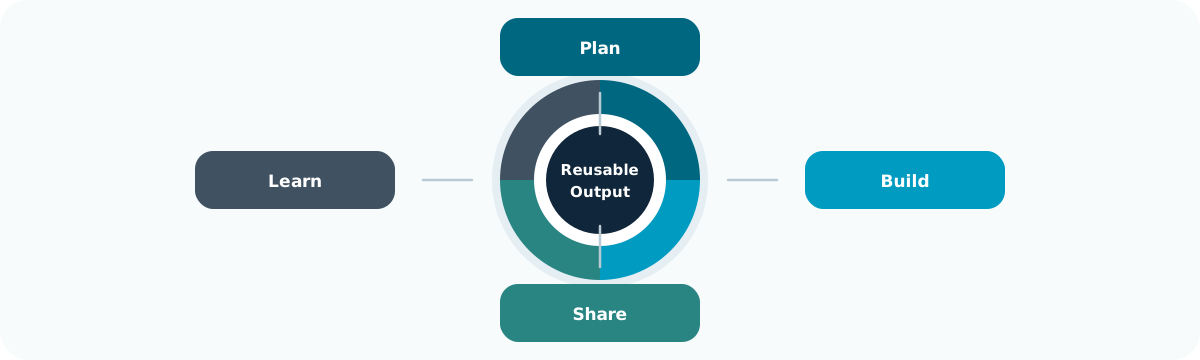
Digital delivery applies concepts from software engineering and modern project management to research. It provides a structured yet flexible framework for coordinating work, ensuring reproducibility, and maintaining visibility across teams and tools.
Research today rarely occurs in isolation: projects depend on complex workflows, interdisciplinary teams, and shared digital infrastructure. Delivering high-quality, reproducible research therefore requires not only technical skill, but intentional design of digital processes.
The traditional research pipeline—design, collect, analyse, publish—provides clarity but lacks adaptability. Digital delivery reimagines this as a cyclical model in which research evolves through continuous refinement, validation, and dissemination.
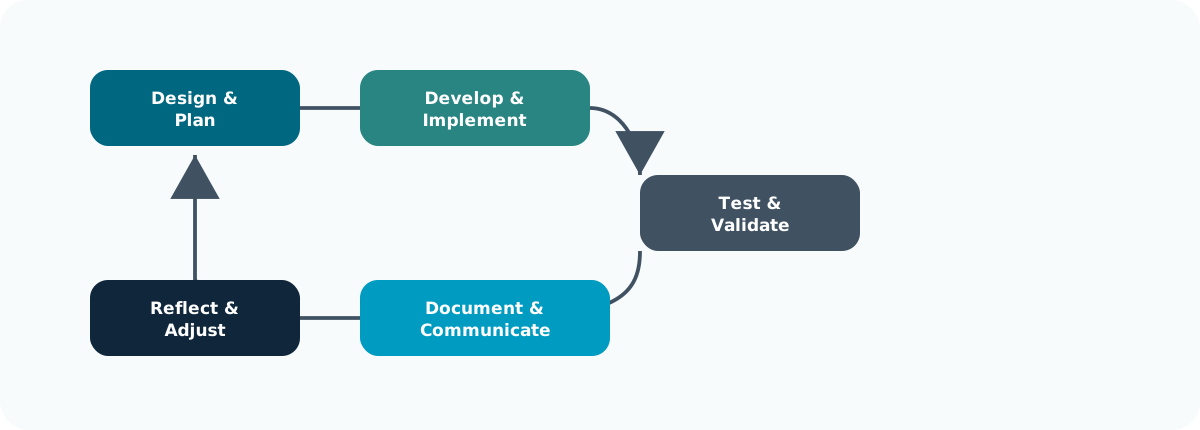
🔁 The loop gives teams permission to adjust the plan when evidence, blockers, or stakeholder needs change.
| Dimension | Description | Example in Research |
|---|---|---|
| Transparency | Visibility of process and outcomes | Shared repositories and live dashboards |
| Reproducibility | Every change traceable and repeatable | Git versioning, containerised environments |
| Automation | Reduce manual repetition | Continuous integration for code and analysis |
| Traceability | Link datasets, methods, and outputs | Persistent identifiers and metadata tracking |
| Adaptability | Adjust plans as knowledge evolves | Rapid prototyping, incremental analysis |
🧩 A digitally delivered project is not faster by default—it is clearer, more auditable, and easier to sustain.
Research teams now operate within an ecosystem of interconnected tools that support planning, analysis, and dissemination.
| Function | Example Tools | Contribution to Delivery |
|---|---|---|
| Planning & Tracking | Trello, Planner, Jira | Clear visibility of tasks and dependencies |
| Code & Version Control | GitHub, GitLab | Collaborative change management |
| Automation | GitHub Actions, Jenkins, Snakemake | Ensures consistent builds and tests |
| Documentation | Quarto, MkDocs, Sphinx | Integrates narrative with computation |
| Communication | Teams, Slack, Overleaf | Maintains alignment and transparency |
| Data Provenance | Dataverse, Zenodo | Tracks lineage and credit |
💡 Effective digital delivery is achieved not by more tools, but by thoughtful integration between them.
Adopting digital delivery means:
🧭 Small delivery loops keep work visible without turning research into a rigid production line.
Share one way digital delivery could prevent inefficiency or data loss in your own research.
Digital delivery depends on thoughtful planning and structured coordination, particularly when projects involve multiple contributors, tools, and datasets. Unlike traditional project management, digital coordination values clarity, visibility, and feedback over hierarchy.
| Element | Purpose | Typical Practice |
|---|---|---|
| Goal Definition | Establish clear deliverables | SMART or OKR frameworks |
| Scope Management | Define boundaries of work | Versioned milestones, phased releases |
| Role Clarity | Clarify who owns what | Contributor matrices, codeowners files |
| Dependency Mapping | Understand interlinked tasks | Workflow diagrams or dependency graphs |
| Progress Monitoring | Keep momentum visible | Kanban boards, status dashboards |
| Risk Adaptation | Identify and mitigate early | Continuous risk registers, peer review |
Digital projects often involve researchers, analysts, data stewards, and technical leads. Coordination is achieved through shared visibility and mutual accountability, not through micromanagement.
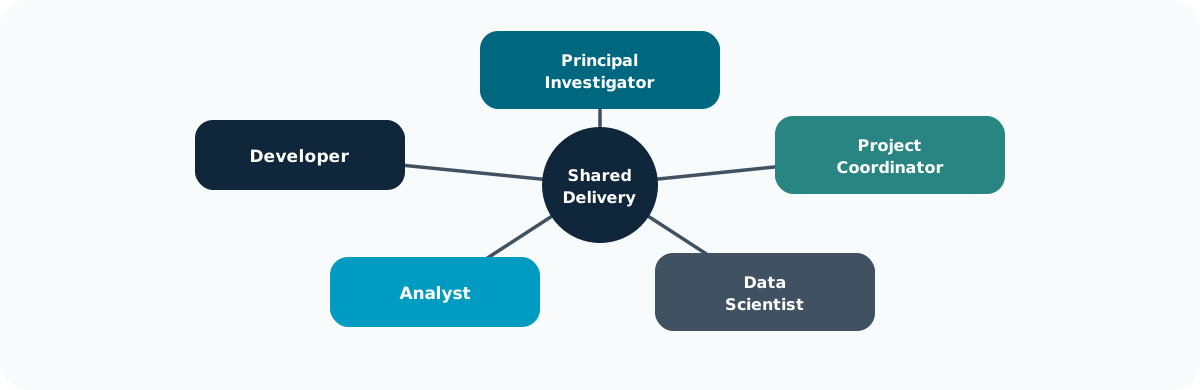
🧭 Roles overlap in practice; the point is to keep handovers visible.
Quantitative and qualitative metrics provide complementary perspectives.
| Metric Type | Examples |
|---|---|
| Throughput | Tasks completed, datasets processed |
| Quality | Review outcomes, test pass rate |
| Engagement | Participation in reviews, feedback received |
| Sustainability | Reuse of workflows, modular code adoption |
⚙️ What gets measured gets improved—choose metrics that reflect learning and progress, not just volume.
Discuss your answers with the pleanry…
Agile thinking offers a lightweight, structured way to organise complex, uncertain work. It replaces static planning with adaptive, iterative learning cycles. In research, this allows teams to balance rigour with responsiveness.
Agile is not about speed but responsiveness—learning quickly from each cycle and adapting accordingly. It fits naturally in data-rich, evolving research environments.
| Agile Value | Applied to Research |
|---|---|
| Individuals and collaboration over rigid processes | Team dialogue over documentation |
| Working outputs over elaborate plans | Delivering analyses or prototypes early |
| Responding to change over following a fixed plan | Reframing hypotheses when new data emerge |
| Stakeholder interaction over isolation | Continuous feedback from supervisors or partners |
💡 Agile in research means treating discovery as a process of continuous testing and refinement.
A sprint is a short, focused cycle (often 1–2 weeks) in which the team commits to delivering a defined output. Each sprint closes with reflection and planning for the next.

🕒 The sprint boundary keeps work small enough to review and improve.
| Stage | Goal | Research Example |
|---|---|---|
| Planning | Select achievable goals | Identify analyses for current dataset |
| Execution | Deliver work incrementally | Implement methods, run tests |
| Review | Evaluate outcomes | Share findings or visualisations |
| Retrospective | Improve process | Identify blockers, refine approach |
🧠 Sprints turn complexity into a rhythm of progress and learning.
| Meeting Type | Purpose | Frequency |
|---|---|---|
| Sprint Planning | Define work and goals | Start of sprint |
| Daily Stand-up | Update and unblock | 10–15 min each day |
| Sprint Review | Present outcomes | End of sprint |
| Retrospective | Reflect on process | Immediately after review |
Agile and digital delivery both depend on collective ownership. A sustainable research culture grows from shared responsibility, openness, and trust.
Research excellence relies not only on technical skill but also on collaboration and reflection. Agile encourages distributed leadership and mutual support.
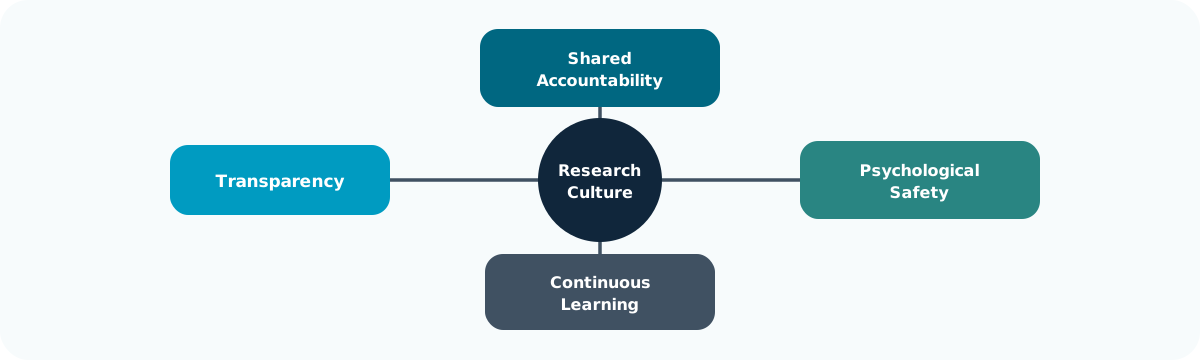
💬 A healthy delivery culture makes issues discussable before they become project risks.

| Practice | Effect |
|---|---|
| Co-developing questions | Aligns goals and expectations |
| Sharing work in progress | Builds feedback loops |
| Rotating facilitation roles | Encourages distributed leadership |
| Reflective reviews | Embed learning within delivery |
| Recognising collective success | Reinforces collaborative norms |
🤝 Shared ownership means everyone contributes to both outcomes and improvement.
Constructive feedback turns collaboration into continuous calibration.
🔁 Feedback is not correction—it’s learning in motion.