
Data protection forms the legal foundation for ethical and compliant research practice. Understanding the regulatory environment enables researchers to manage risk, protect participants and maintain trust.
⚖️ The UK General Data Protection Regulation (UK GDPR) and the Data Protection Act 2018 govern all processing of personal and special category data in research.
Personal data means any information relating to an identified or identifiable person. This includes not only names and contact details but also identifiers such as location, IP address, or images.
Examples in research:
🧠 If someone can be identified directly or indirectly, the data should be considered personal.
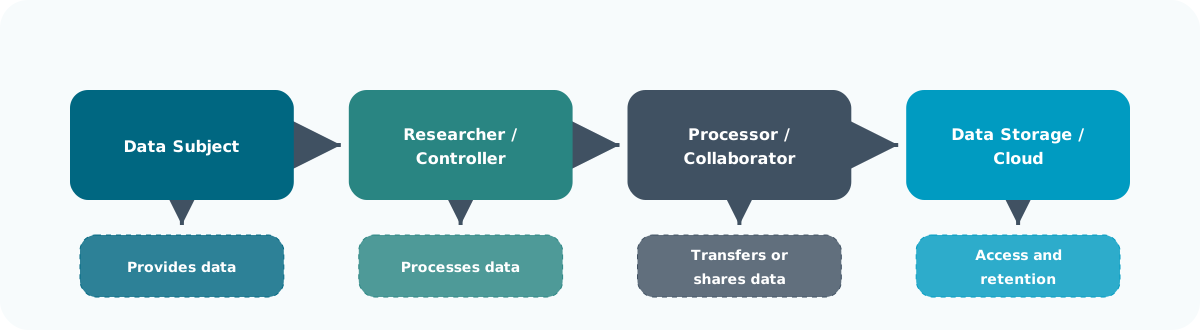
🧭 The key distinction is who decides why data is used, who acts on instructions, and where access is controlled.
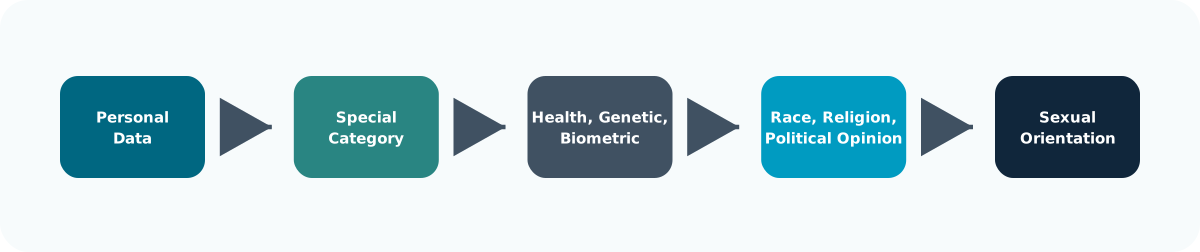
Article 6 UK GDPR provides six lawful bases for processing personal data. Research typically relies on two of them, but all are listed for completeness.
Consent is not a universal lawful basis for research.
It complements ethical approval and transparency but does not replace institutional safeguards, accountability, or appropriate governance.
🧩 Research exemptions exist but require proportionality and documentation.
⚠️ Article 9 data raises the evidence threshold because misuse can harm people directly.
Special category data (Article 9) require both a lawful basis (Art 6) and a specific Article 9 condition, commonly scientific research with appropriate safeguards.

Safeguards must ensure that personal data are used responsibly:
🔐 Good governance transforms legal compliance into ethical research practice.
| Role | Responsibility |
|---|---|
| Data Controller | Determines purposes and means of processing (often UoN) |
| Processor | Processes data on behalf of controller (e.g., cloud host) |
| Joint Controllers | Shared decision-making between partners |
| Data Protection Officer (DPO) | Oversees compliance, provides advice |
Objective: Using the scenario card assigned to your group, identify the main data protection risks and rank the specific components of your scenario from lowest to highest risk.
Instructions:
Plenary reflection: Which characteristics in your scenario elevate risk?

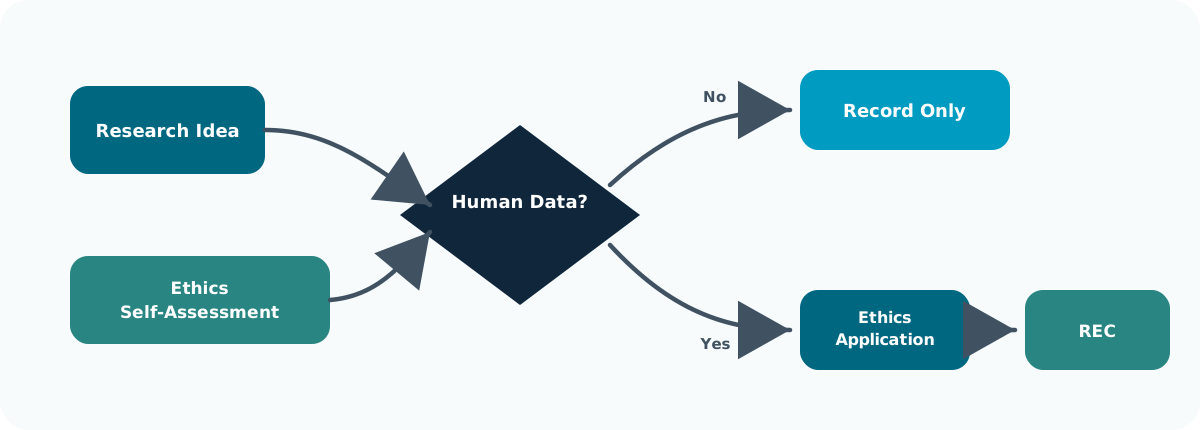
Ethical review ensures that research is conducted with integrity, transparency and respect. At the University of Nottingham, ethical standards are guided by the Code of Research Conduct and Research Ethics.
| Principle | Meaning |
|---|---|
| Respect | Uphold autonomy, dignity and rights of participants |
| Integrity | Ensure honesty and transparency in all research stages |
| Responsibility | Prevent harm and manage potential risks |
| Accountability | Maintain records and be answerable for decisions |
🧭 Ethical practice is both a regulatory requirement and a marker of research quality.
🧭 Early self-assessment prevents ethics and governance questions from becoming late-stage delays.

Objective: Classify all data types in your scenario card using UoN’s Information Classification Framework and assign appropriate storage and access controls. Steps:
Plenary reflection: Which factors most strongly affect whether review is needed? Where do grey areas appear?

Research data must be handled according to sensitivity and risk. UoN’s Information Classification Framework defines four tiers: Public, Internal, Confidential and Highly Confidential.
🔐 Classification should be decided before storage and sharing choices are made.
| Level | Description | Examples | Storage Guidance |
|---|---|---|---|
| Public | Freely shareable data | Published results, open datasets | Repositories, websites |
| Internal | Limited to UoN community | Teaching materials | SharePoint, OneDrive |
| Confidential | Sensitive but manageable risk | Interview transcripts, research drafts | Research drives |
| Highly Confidential | High-risk personal or security data | Clinical data, restricted partnerships | Secure servers, encrypted access |
Objective: Determine the information security requirements for the project described on your scenario card.
Instructions:
Plenary reflection: How do teams balance openness and risk? Which criteria most influenced your decisions?

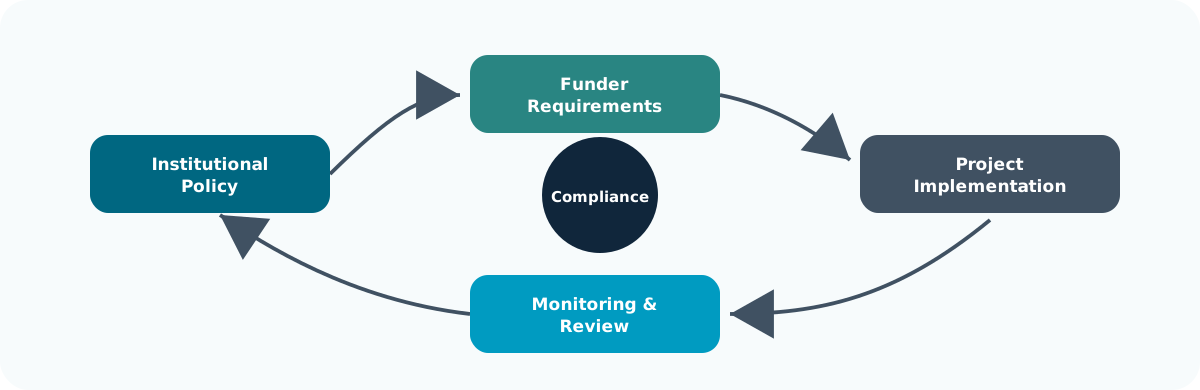
Data governance operates across multiple levels: institutional, national and funder each setting standards for responsible research and compliance.
| Framework | Focus | Examples |
|---|---|---|
| UKRI Trusted Research & Innovation | Secure international collaboration | Partnership risk assessments |
| UKRI Open Research Data Policy | Sharing with safeguards | FAIR data principles |
| Data Protection Act 2018 | Legal controller obligations | Research exemptions with safeguards |
| Export Controls | Sharing restrictions | Sensitive collaborations |
📋 Compliance is maintained through repeated checks, not a single form at the start.

Modern research governance relies on a set of standard documents that ensure transparency, accountability and risk-aware data management throughout the project lifecycle.
| Document | Purpose | When Required |
|---|---|---|
| DPIA – Data Protection Impact Assessment | Identifies and mitigates high-risk processing (e.g., special category data, monitoring, novel tech). | Mandatory for any high-risk activity under UK GDPR; often required for clinical, AI-enabled or large-scale personal data studies. |
| DAR – Data Access Request / Data Access Review | Records, evaluates and approves requests to access sensitive or controlled datasets; ensures proportionality and security. | When researchers need access to restricted, confidential or external datasets. |
| DMP – Data Management Plan | Specifies how data will be collected, stored, secured, shared, preserved and disposed of. | Required by UoN, UKRI and most funders; drafted at proposal stage and updated throughout the project. |
| Data Sharing / Collaboration Agreements (DSA / DCA) | Define roles (controller/processor), safeguards and transfer conditions. | When sharing data with external partners, processors or internationally. |
| Participant Information & Consent Materials | Provide transparency and ensure voluntary, informed participation. | Required whenever collecting personal data directly from participants. |
| Risk Assessments (Information Security, Fieldwork, Technical) | Document digital, physical and technical risks and their controls. | Required for projects involving sensitive data, fieldwork or specialised systems. |
🗂️ Good documentation is the backbone of trustworthy research and strong data governance.
| Actor | Responsibility |
|---|---|
| Researcher | Follow ethical and legal guidelines |
| PI | Ensure compliance and oversight |
| Faculty / REC | Review and approve projects |
| DPO / Legal | Provide advice, investigate breaches |
| Funders | Define standards and expectations |
🌍 Compliance works best when embedded in daily workflows, not treated as an afterthought.
Objective: Map your scenario card to relevant institutional, funder and legal policies and identify responsibilities across the project team.
Instructions:
Plenary reflection: Which policy areas overlap most frequently across scenarios?