
Research Data Management (RDM) ensures that data are organised, secure, documented and preserved to support research integrity, reproducibility and reuse. Effective RDM is a shared responsibility across project roles and institutional services.
| Role | Key Responsibilities |
|---|---|
| Principal Investigator (PI) | Accountable for project-level RDM, retention and preservation. Ensures compliance with funder and institutional policies. |
| Researchers | Day-to-day organisation, secure handling, documentation and quality control. Implement the DMP. |
| Project Team | Shared responsibility for access, version control and documentation. |
| Library (RDM Support) | Advises on metadata, citation, archiving and FAIR compliance. |
| Digital Technology Services | Provides secure storage, backup and collaboration platforms. |
| Information Security | Defines classification tiers and enforces access controls. |
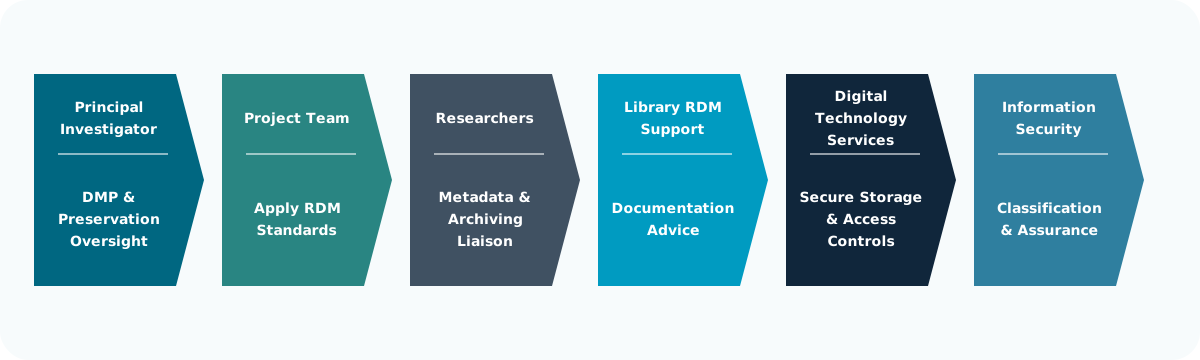
🧩 RDM works best when responsibilities are explicit rather than assumed.
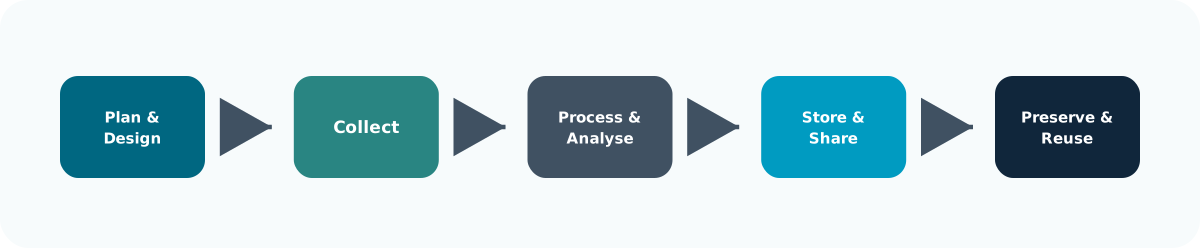
🔁 Decisions made early affect whether data can be understood and reused later.
| Platform | Purpose | Notes |
|---|---|---|
| OneDrive | Individual work area | Automatic versioning and sync |
| SharePoint / Teams | Collaborative workspace | Fine-grained permissions, version control |
| CPS Research Storage | Group-managed access | Backed-up, scalable |
| TRE Secure Storage | Sensitive/confidential data | Encryption, limited access, audit logs |
🔐 Choose storage based on sensitivity, access needs and classification level.
Objective: Identify how roles and responsibilities would operate for the research project described on your scenario card.
Instructions:
Reflection: Which RDM responsibilities are most often misunderstood or overlooked within real projects?
## What is a data managment plan
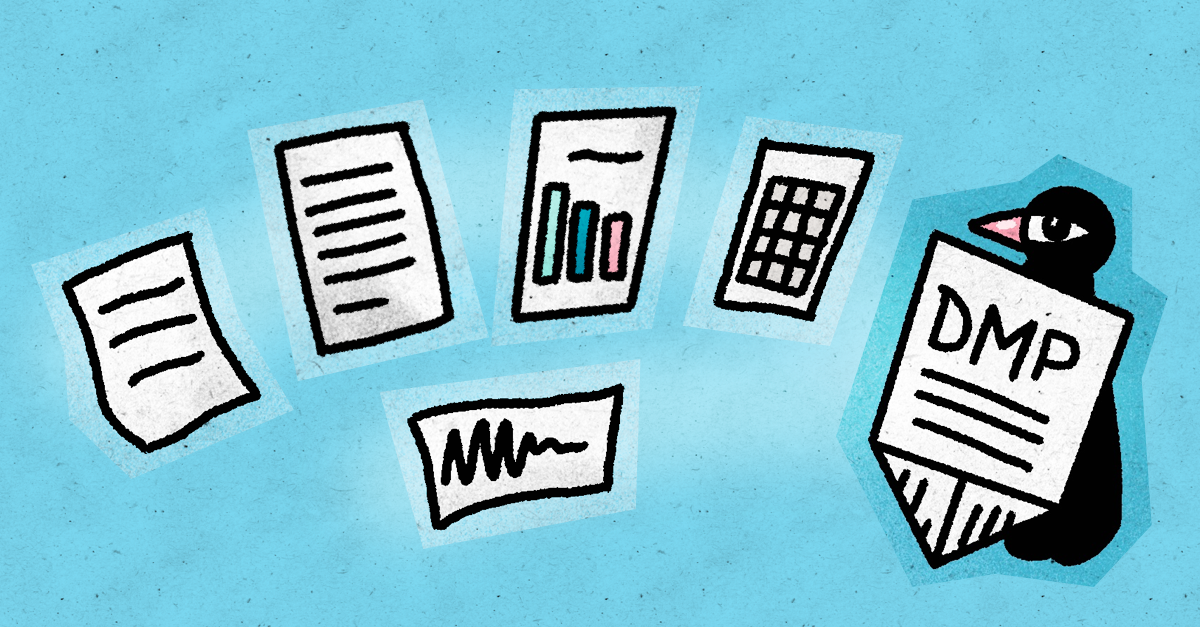
A Data Management Plan (DMP) describes how data are created, managed and preserved. It clarifies accountability, ensures transparency and supports compliance with institutional and funder requirements.
| Purpose | Outcome |
|---|---|
| Clarify expectations | Reduces confusion and duplication |
| Ensure compliance | Meets funder and institutional requirements |
| Improve reproducibility | Ensures transparency and documentation |
| Manage risk | Prevents loss, breaches and misuse |
🗂️ A DMP is both a planning tool and a compliance artefact.
Funders such as UKRI, Wellcome and Horizon Europe mandate DMPs at proposal stage. The UoN template aligns with these standards and includes:
DMPs complement ethical review and governance processes:
🔄 DMPs should evolve as the project and data context change.
Objective: Draft the core elements of a Data Management Plan tailored to the scenario on your card.
Instructions:
Reflection: Which components of your draft DMP are most likely to require revision as the project evolves?
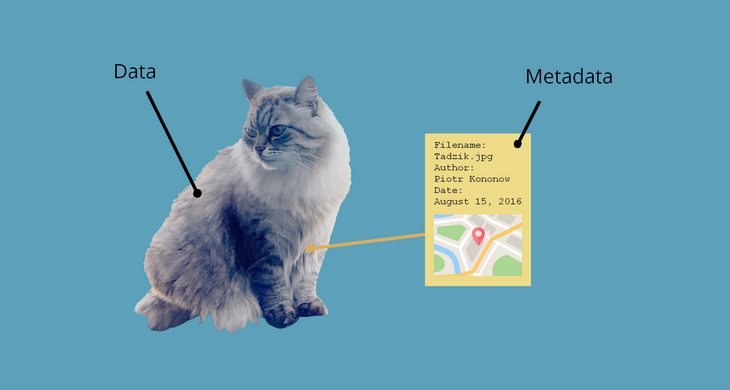
Effective RDM relies on consistent organisation and clear documentation. Structured data and metadata support collaboration, transparency and long-term preservation.
Use stable, descriptive and version-controlled names:
YYYYMMDD_project-feature_description_vNN.extExample
20250112_survey_raw_v01.csv
20250115_audio_int01_redacted_v02.wav
20250120_analysis_results_v03.parquet
🗃️ Meaningful naming prevents confusion and simplifies version tracking.
| Document | Purpose |
|---|---|
| README.md | Overview of project and data organisation |
| CODEBOOK.md | Defines variables, units and coding schemes |
| CHANGES.md | Tracks version history |
| DATA DICTIONARY | Lists fields, formats, provenance |
🧩 Metadata describes context, structure and provenance for reuse.
🌐 Select standards appropriate to your discipline and repository.
Objective: Develop a folder structure and metadata approach appropriate for the research scenario on your card.
Instructions:
Reflection: Which metadata elements most strongly influence long-term reusability?

Reusable data align with the FAIR principles:
These are designed to promote transparency and maximise research value.
| Principle | Features | Practice Example |
|---|---|---|
| Findable | Persistent IDs, indexed metadata | Dataset DOIs, ORCID iDs |
| Accessible | Clear access conditions, stable landing pages | Repository with metadata only |
| Interoperable | Open formats, controlled vocabularies | CSV + ontology alignment |
| Reusable | Licences, provenance, documentation | CC BY licence + CODEBOOK.md |
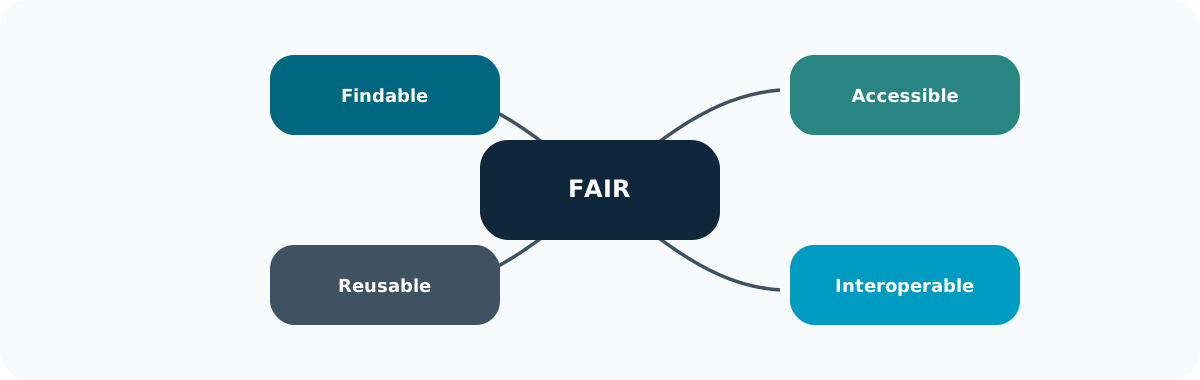
♻️ FAIR is a reuse test: can someone find, understand, access, and responsibly use the dataset?
Objective: Evaluate how data from your scenario card could meet the FAIR principles and identify improvements.
Instructions:
Reflection: Which FAIR principle presents the greatest challenge in your scenario and what constrains it?