A Brief Origin Story: The Beginnings of AI (~1950)
- Artificial Intelligence (AI) emerged in the 1950s
- Initial ideas were around whether machines could replicate human thought.
🤔 Alan Turing argued that intelligence might be understood through behaviour rather than internal processes, leading to the famous question: Can machines think?
Expansion of Rule-Based AI (1960–1970)
Early AI focused on symbolic reasoning.
Intelligence was treated as a problem of logic, rules, and formal symbols.
- Human reasoning was assumed to be explicit and decomposable
- Knowledge could be encoded as if–then rules
- Computers would outperform humans by applying rules faster and more consistently
⚙️ If reasoning can be fully specified, it can be automated.
Growth of Structured Knowledge Systems
Large, structured knowledge bases emerged.
Expert knowledge was represented using rule sets, semantic networks, and frames.
- Emphasis on capturing specialist reasoning explicitly
- Knowledge engineered directly into the system
- Reasoning executed by deterministic rule application
Expert systems became prominent as a way to formalise human expertise.
🧠 Early AI treated thinking as rule-following, not pattern-learning.
The First AI Winter (1970–1980)
Expert systems struggled to scale.
Human expertise had to be encoded manually, often as thousands of explicit rules for diagnosis, recommendation, or classification.
- Rule sets became increasingly large and brittle
- Contradictions and edge cases multiplied
- Maintaining internal consistency became impractical
- System performance degraded as complexity increased
🧠 At the same time, early research into neural networks stalled following early mathematical criticism, accelerating the loss of confidence and funding.
The Emergence of Machine Learning (1980–1995)
in the 80s ML emerged when researchers realised that instead of telling computers how to solve problems, they could let them learn from examples.
Three conditions enabled this transition:
- Data was being generated at scale in science, finance, and the internet.
- Statistical methods improved (e.g., Bayesian modelling, maximum likelihood).
- Computers became fast enough to fit models to real datasets.
📈 ML became the dominant paradigm because it could adapt to messy, uncertain, real-world problems.
Core Machine Learning Approaches
ML is based on three main approaches:
| Supervised Learning |
Learns from labelled examples to predict outcomes |
classification, regression |
regression, random forests, SVMs |
| Unsupervised Learning |
Finds structure in unlabelled data |
clustering, dimensionality reduction |
k-means, PCA, topic modelling |
| Reinforcement Learning |
Learns actions through trial-and-error with rewards |
control, optimisation, agents |
Q-learning, policy gradients |
Statistical AI → Deep Learning (1995–2010)
In the mid 90s, research shifted toward data-driven methods, with probabilistic graphical models and support vector machines (smvs) becoming standard in scientific and industrial settings.
A landmark moment came in 1997 when IBM’s Deep Blue defeated Garry Kasparov, demonstrating the power of specialised computation and statistical optimisation.
🧠 Deep learning transformed AI performance across multiple domains by learning rich features automatically.
Deep learning → Natural Language Processing (NLP) (2000s–2016)
In the early 2000s Natural Language Processing (NLP) emerged as a field of AI that focuses on understanding and generating human language. It focused on tasks such as translation, sentiment analysis, summarisation and question answering.
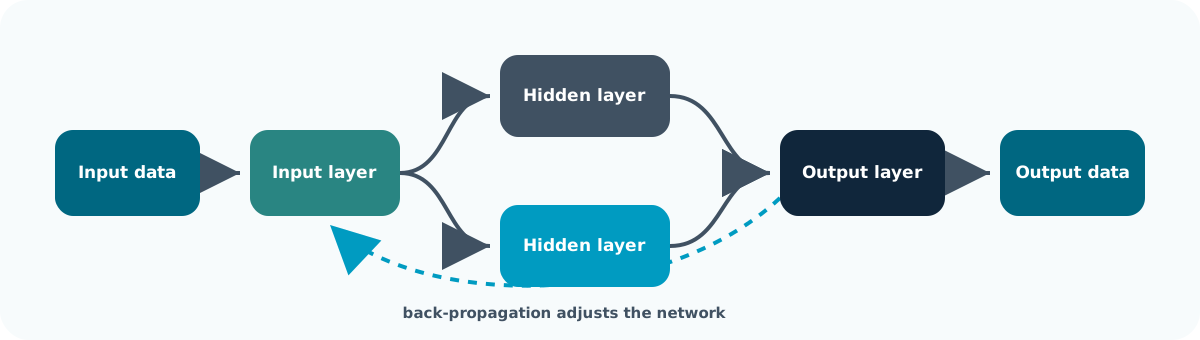
🧠 Learning improves when output errors are fed back into the model rather than treated as final answers.
🗣️ Language is challenging because meaning depends on context and relationships across sentences.
A field ready for change (2014-2016)
Various deep learning models attempted to address the NLP problem, but these had their limitations:
- They were slow because they processed text step by step
- They had difficulty capturing long-range relationships (i.e. semantic meaning)
- They were hard to scale to large datasets
🔁 Researchers needed models that could look at text in larger blocks (or all at once).
Maintaining Context
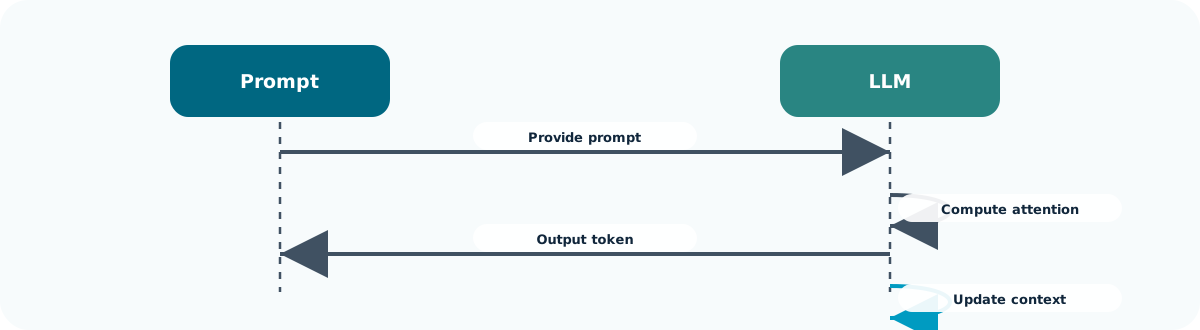
At each step, the model attends over the tokens currently in its context window, using self-attention to weigh which parts of the prompt and prior output matter most for predicting the next token.
🧭 Context is active memory for the current exchange, not a guarantee of understanding.
The cogs behind Generative AI
By predicting the most likely next token from prior context, transformer models can learn statistical patterns that can be reused across tasks, enabling flexible inference beyond simple memorisation.
✨ Given a large enough training set, this allows them to generate responses the appear thougtful.
From Scale to Generality (2020–present)
- 2020: GPT-3 (~175B parameters)
First truly large-scale autoregressive model demonstrating broad, task-agnostic capabilities.
- 2021: PaLM (~540B parameters)
Empirical validation of scaling laws, with notable gains in multilingual performance and reasoning.
- 2023: GPT-4, Claude, Gemini (parameter counts undisclosed but likely Trillion-scale)
Shift toward multimodality, alignment, safety, and system-level optimisation rather than raw scale alone.
- 2024–2025: Mixture-of-Experts and hybrid systems
Trillion-scale effective capacity via sparse activation, retrieval-augmented generation, and domain-specialised models.
🚀 Foundation models marked a transition from task-specific AI systems to general-purpose computational platforms.
Summary
AI began with rules but moved toward learning. Deep learning enabled rich representations, and sequence models advanced language processing. Transformers removed key bottlenecks, allowing the creation of foundation models and LLMs.
Big shift now is on optimisation as running large models is expensive!
🌐 Modern generative AI is the result of many incremental breakthroughs.
Task: Questionaire
Live lesson component
Questions and live results are available during the taught session.
AI as a structural shift in research practice
Generative AI represents a structural change in research by compressing intellectual labour associated with drafting, synthesis, translation, and technical scaffolding.
Rather than replacing expertise, it reallocates researcher effort from production to evaluation, verification, and judgement.
✍️ The key transformation is therefore epistemic rather than technical: researchers are increasingly positioned as editors of reasoning rather than sole producers of intermediate artefacts.
Compression of the research lifecycle
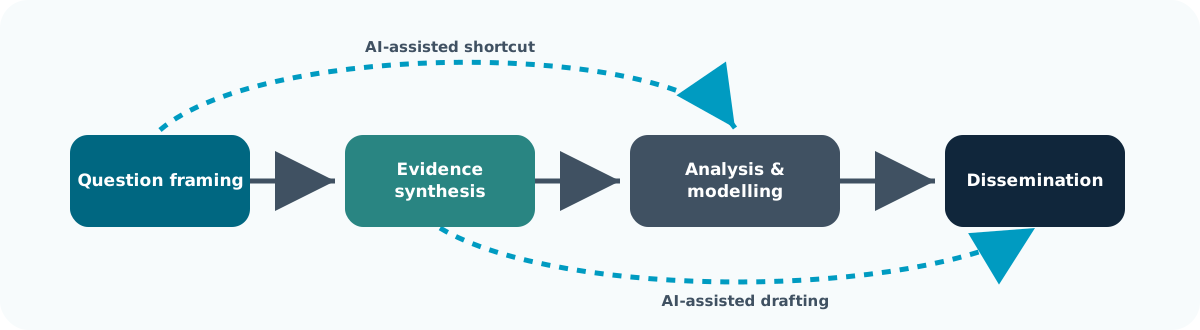
AI-enabled workflows can collapse traditionally sequential stages of research, reducing temporal distance between ideation, analysis, and dissemination.
⏸️ Faster movement between stages makes deliberate review points more important, not less.
⏸️ This compression increases throughput but reduces natural pauses for critical reflection, peer discussion, and methodological reconsideration. Opportunities therefore emerge only when deliberate checkpoints are reintroduced.
Where genuine opportunities arise
Opportunities from AI in research are best understood as capacity multipliers
Common high‑value gains include:
- rapid orientation in unfamiliar or interdisciplinary literatures
- broader exploration of methodological or analytical alternatives
- reduced time spent on repetitive technical boilerplate (e.g. code scaffolds, formatting)
- improved accessibility and clarity of written communication
- faster iteration during early exploratory phases
⏱️ These benefits are particularly significant in environments characterised by limited time, high cognitive load, or interdisciplinary translation.
Expansion of exploratory space
AI can increase the breadth of exploration by lowering the cost of asking “what if?” questions, it can:
- Recomend alternative methods
- Perform sensitivity analyses
- Reframe research questions
- Offer alternative explanatory narratives
✅ This can improve robustness if exploration is paired with explicit selection criteria and validation.
A simple research risk matrix
| summarising a public guidance page for personal notes |
low |
public source, easy to verify |
| generating boilerplate code against toy data |
low to medium |
technical errors still possible |
| comparing unpublished drafts across collaborators |
medium |
confidentiality and attribution issues |
| analysing identifiable participant material in a public tool |
high |
ethics, governance and disclosure failure |
| asking AI to produce findings or conclusions from your data |
high |
interpretation and accountability risk |
⚖️ The point is not to ban AI in difficult areas. It is to match the tool, safeguards and review burden to the stakes.
Accessibility and inclusion
When used carefully, AI can also support:
- clearer expression for non‑native speakers
- improved readability for diverse audiences
- translation across disciplinary vocabularies
- structured drafting for early‑career researchers
🌍 These gains offer both social and pedagogical impact, not merely technical.
Task: risk relocation audit (5 minutes)
Plenary Discussion:
For each research stages State how AI could reduce effort at that stage. Can you also identify potential risks of the approach?
- Hypothesis generation
- analysis and interpretation
- dissemination.
Ethics, Governance and Academic Integrity
The condition for opportunity: retained ownership
AI‑enabled capacity is valuable only when the researcher retains ownership of:
- assumptions
- analytical choices
- interpretation
- uncertainty
🚨 Where ownership is ceded, opportunity are rapidly converted into risks.
Capacity gain requires explicit control mechanisms
Effective use of AI in research therefore requires intentionally designed safeguards:
- Define the research question and assumptions before using AI
- treat AI outputs as hypotheses, not evidence
- verify all claims against primary sources
- map key claims directly to results
🎛️ Opportunity only scales with control. Speed without control does not create research value.
Why governance is now a research necessity
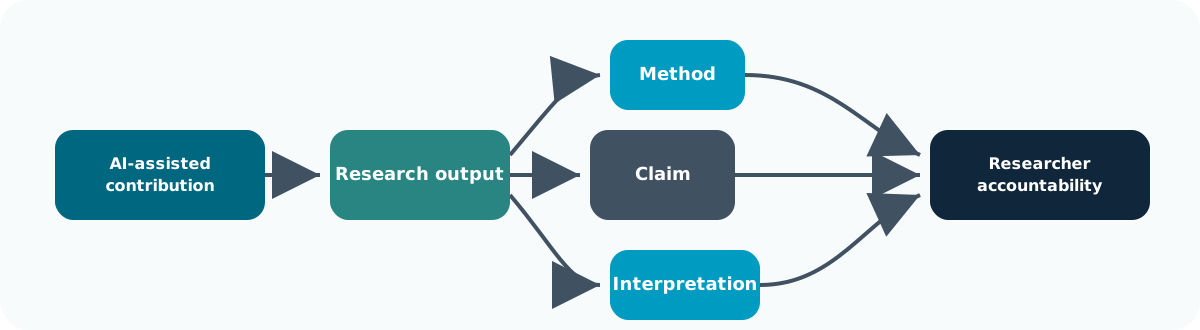
Generative AI makes it easier for substantive contributions to be produced rapidly and invisibly:
🧾 Accountability cannot be delegated to the tool that generated or shaped the material.
🧾 This strains established norms around authorship, contribution, provenance, and accountability.
False authorship: the institutional framing
Most universities, including the University of Nottingham, explicitly treats unpermitted or unacknowledged AI assistance as false authorship, regardless of intent.
This includes AI contribution to:
- text and argumentation
- code and analysis outputs
- images, figures, or other generated artefacts
📢 It is your responsibility to disclose the use of AI in reasearch.
Permission is contextual, not assumed
AI acceptability varies by:
- assessment instructions
- discipline norms
- collaboration agreements
- funder/publisher expectations
🔐 The governance principle: permission must be explicit; ambiguity is risk.
Accountability: what must remain human
The researcher must be able to:
- justify key assumptions
- reproduce results
- defend claims against evidence
- describe limitations and uncertainty
👤 AI can assist, but as a tool, cannot carry responsibility for the quality of research.
Transparency and traceability as research norms
Traceability aligns with established research integrity practices.
| Tool(s) and version(s) |
provenance and reproducibility |
| Where AI influenced decisions |
auditability of reasoning |
| What was verified (and how) |
defensible claims |
| What was not verified |
honest uncertainty |
👤 Data transparency is not an extra requirement created by AI; it should be an extension of normal research practice.
Contribution boundaries: editing vs substantive generation
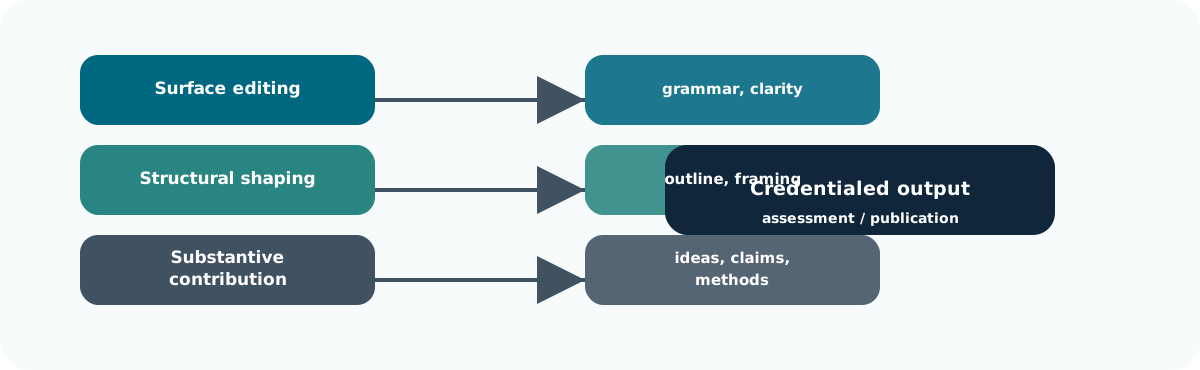
A recurring problem is distinguishing language editing (clarity, structure) from substantive contribution (ideas, methods, claims, interpretation)
👤 The risk rises when the tool starts shaping claims, methods, interpretation, or assessed work.
👤 The critical question is not whether AI was used, but how it was used
Integrity risks that look “benign”
Research-relevant risks often arise from normal workflow choices:
- Accepting a polished paragraph without mapping claims to results
- Adopting analytic code without validation
- Using a summary that narrows the literature space prematurely
⚠️ Failing to disclose material AI contribution where required may seem minor, but can have significant ethical and governance implication.
What good disclosure achieves
Disclosure is not a punishment; it enables:
- clearer attribution of intellectual work
- defensible scholarship
- auditability and reproducibility
- trust within teams and with audiences
📝 You make a claim? Was AI involved? If Yes, keep an audit of how its involved and disclose it!
Data Security and the Research Threat
Why AI materially changes research data risk
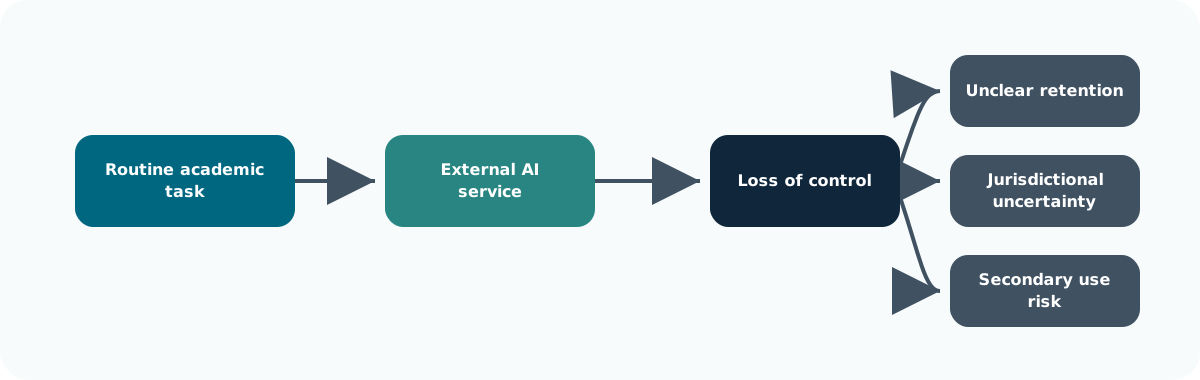
Many AI tools operate outside institutional infrastructure and governance controls.
This transforms routine academic actions (summarising notes, refining code, drafting interpretation) into potential boundary-crossing events that may bypass established safeguards.
🔐 The boundary crossing is the critical moment: once material leaves governed systems, controls become uncertain.
🔒 The dominant risk is not malicious intent but loss of visibility and control once material leaves institutional systems.
High-risk material: common categories
| Personal / sensitive |
clinical, genetic, geolocation |
legal and ethical obligations |
| Qualitative text |
interviews, free text, notes |
re-identification risk |
| Unpublished work |
manuscripts, result tables |
premature disclosure |
| IP / commercial |
methods, pipelines, agreements |
loss of competitive advantage |
| Security material |
tokens, keys, internal URLs |
direct compromise |
🧩 Risk frequently arises from aggregation, not single items.
De-identification is not a sufficient safeguard
Removing explicit identifiers does not eliminate disclosure risk.
Residual risk persists through rare attribute combinations, contextual cues in narrative text, small-n summaries, or linkage with external information.
🛠️ The practical implication is operational rather than theoretical: “Anonymised” does not mean “safe to upload.”
AI systems as unregulated collaborators
A useful governance analogy is to treat external AI services as collaborators who have:
- no contract
- no ethics approval
- no data-sharing agreement
- no enforceable deletion or confidentiality guarantees
🧭 This framing clarifies why minimum necessary disclosure is a defensible default.
Behavioural drift as a security threat
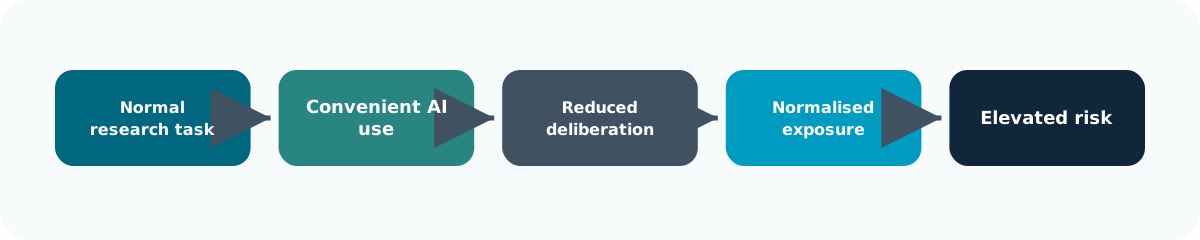
Risk is not only technical; it is behavioural.
Convenience can normalise incremental risk-taking without explicit decision points.
🔍 Drift is dangerous because each individual step can feel too small to question.
🔍 This form of “quiet drift” is harder to detect than discrete policy violations.
Practical implication for researchers
A simple operational test:
📧 Would I be permitted to email this material to an external collaborator without a formal agreement?
If not, it should not be shared with an external AI service. Check with your organisation directly if there are local / secure versions of these tools available for you to use.