By the end of this module, learners will be able to:
This workshop builds on Introduction to AI for Research and Prompting for Research. It assumes familiarity with basic prompting and source checking; no programming background is required.
| Block | Approximate time |
|---|---|
| Opening and framing | 10 min |
| Choosing tools and approaches | 10 min |
| Building inspectable workflows | 10 min |
| Working across the research lifecycle | 10 min |
| Literature reviews | 20 min |
| Qualitative and quantitative analysis | 20 min |
| Agents and research automation | 10 min |
| Grant applications | 10 min |
| Research integrity, action and close | 20 min |
The same model can behave differently when the available sources, tools or instructions change.
🧭 Start with the task, the permitted inputs and the checks you can perform.
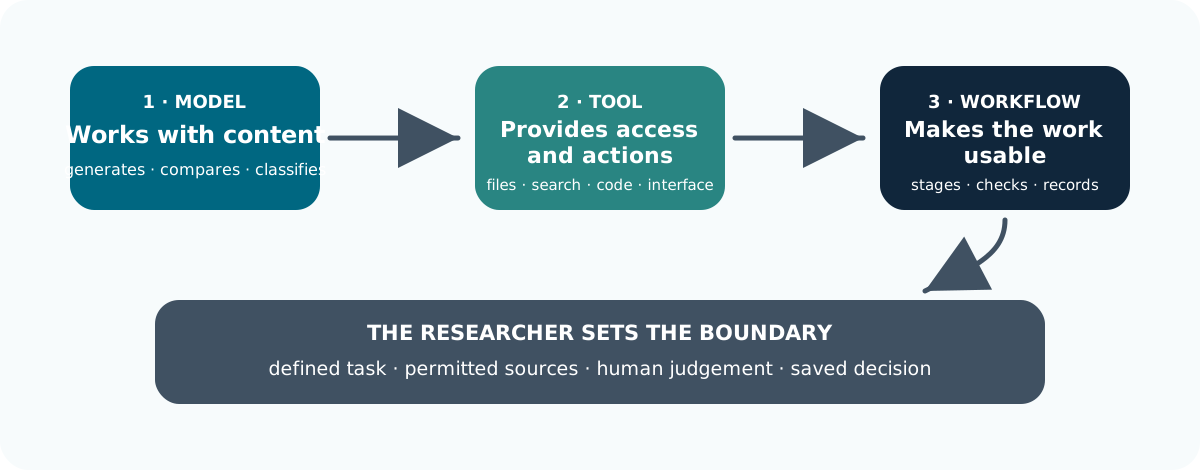
The product name tells you very little about whether they are sutible to use for research processes.
ChatGPT, Claude, Gemini and Microsoft Copilot Chat are products or interfaces. A product may offer several models, choose one automatically and add abilities such as web search, document reading or code execution.
GPT, Claude, Gemini and Mistral are families of models. Where the information is visible, record both the product or service and the model and version.
Match the Tool to the Task: These are starting points, not performance rankings.
| Tool Function | Research Task | Possible Starting Point |
|---|---|---|
| Discovery and search | Refine a question or critique a draft | A general assistant such as Claude, Gemini or an approved Copilot service |
| Discovery and search | Explore a topic or public guidance | Web search with an assistant such as Perplexity |
| Discovery and search | Find papers from a research question | Elicit or Consensus, alongside disciplinary databases |
| Citation connections | Explore related papers | ResearchRabbit or Litmaps |
| Citation connections | Examine how a paper is cited | Scite |
| Document evidence | Ask across a selected collection | Google’s source notebooks, known as NotebookLM and now described as Gemini Notebook; approved document assistants |
| Document evidence | Extract fields across papers | Elicit’s extraction workflows or a structured prompt over approved PDFs |
| Data and code | Work with interview text | An approved assistant or MAXQDA AI Assist |
| Data and code | Develop code and visualisations | GitHub Copilot or an approved coding assistant |
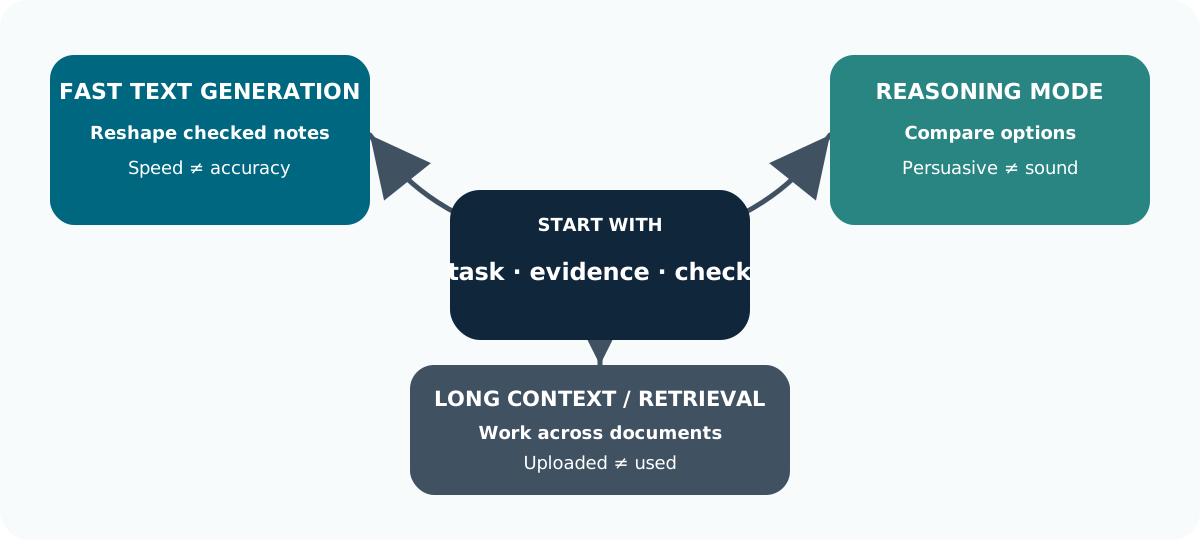
Dont pick tools just because they sound cool!
Different tools and models have different strengths. Do not assume a capability: verify it.
| Check | What to verify |
|---|---|
| Capability | Is the tool good at the task: reasoning, coding, images or long documents? |
| Functionality | Can it actually perform the task you need? |
| Output | Does the result match the source, data or calculation? |
| Data handling | Where is data processed, stored or logged? |
| Use conditions | Are the licence and external connections appropriate? |
Choose the tool for the task, then verify the result.
Compare candidate tools on the same permitted material. Include a straightforward case, an ambiguous case and a question the sources cannot answer.
🔎 Agreement between two AI tools is a reason to check the evidence, not independent confirmation of a finding.
When evaluating which tool is best for a sepecific task what approach would you use?
Example; For the following; What is the single check you would insist on?
The brand name is secondary to the evidence it can access and the checks you can perform.
Before using AI, be clear about what you are trying to do.
A clear starting point helps AI stay focused on the question you actually want to answer.
Be clear about what the AI can use and what a good result should include.
| Include | Example |
|---|---|
| Sources | Use only the supplied material |
| Output | Show where each claim came from |
| Limits | Do not invent details or overstate conclusions |
| Check | Verify important claims yourself |
Keep your instructions separate from the material being analysed.
Give the AI the right material, and make sure it can actually find what you want.
Dont assume an AI tool can interpet every bit of information you give it!
Many document tools first search the uploaded material for relevant passages and then give those to the model.
This is often called retrieval-augmented generation (RAG).
It can make answers easier to trace, but the search step can miss important evidence.
📄 Ask for section headings, printed page numbers or passage locations. Mark the location as unavailable when the tool cannot provide it reliably. Being able to accept a long document does not mean the tool gives equal attention to every page.
For comparisons across many papers:
When a conversation becomes long or changes direction, you are often better starting a new session with the current sources.
Break down the process into its components
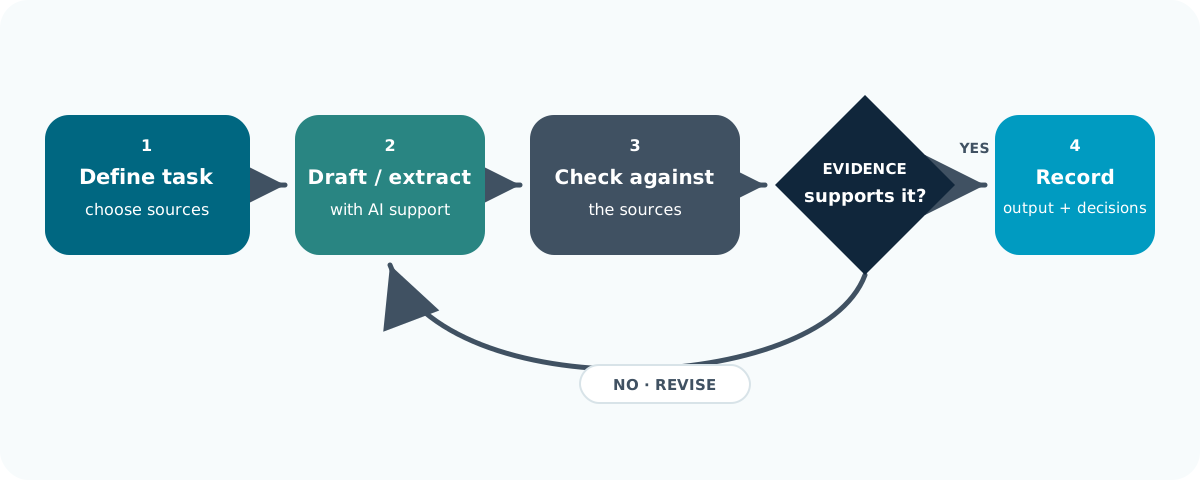
Dont try to do everything in one prompt.
You can ask an AI assistant to:
But you need to check these points yourself against the sources and method.
Asking a real life research assistant to approve their own answer is not independent verification. The same goes for AI.
Task: Compare what sources say about peer writing groups.

Context: I am preparing a research design discussion, not claiming an effect.

Sources: Use only the labelled teaching extracts supplied below.

Process:

First list the sources you can access and any missing information.

Then produce one row per source with: source ID; design; participants;
outcome or concept; finding;source location; limitation; question requiring human review.

Distinguish reported findings from your interpretation.

Use "not reported" for missing details. Do not invent references or values.
Do not combine different outcomes into a single claim of effectiveness.
Finish with disagreements and uncertainties for me to check.Consider the prompt “Read these papers and tell me what my PhD should study.”
What do you think is the single most important change that you could make to improve this?
A defensible workflow would define:
The AI can organise possibilities. It cannot decide what is novel, worthwhile and feasible.
AI can help bring together observations, concepts and existing theory to suggest possible explanations.
Example: Writing becomes more regular during a writing group.
Possible explanations include protected time, accountability, confidence or peer support.
🧭 These are ideas to investigate, not findings.
Lets start with a theoretical project that is studying the affects of study groups on writing time.
They observe that after a 6 week period of study group meetings, people tended to write more.
Why might this happen?
The writing group creates protected time.
What else could explain it?
eadlines, supervision, motivation or workload.
The same observation can often be explained in several different ways.
Normally a resescher would build a theory to test how or why different concepts might be related.
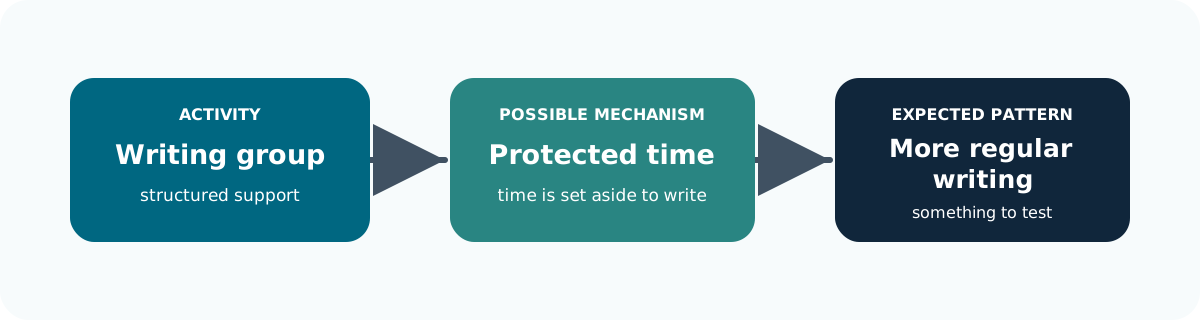
Other factors may influence that relationship, such as motivation, workload or caring responsibilities: A plausible explanation is still something to test.
A theory becomes more useful when it leads to something that could be observed.
| Proposed explanation | What might we expect? |
|---|---|
| Protected time matters | Writing becomes more regular when sessions occur |
| Accountability matters | Peer contact influences drive to write |
Explanation should only be made into prediction based on evidence
AI can help expose weaknesses before you commit to an idea.
It can help you explore:
📝 You can actually ask AI to challenge the idea, not just support it.
Once you have possible explanations, the normal approach is to compare them against the evidence.
Does the evidence support one or more of our explanations?
Does anything contradict some of them?
What evidence is still missing?
Keep evidence, researcher interpretation and AI suggestions as separate components in you work.
AI can help generate and challenge explanations, but it cannot establish that they are correct.
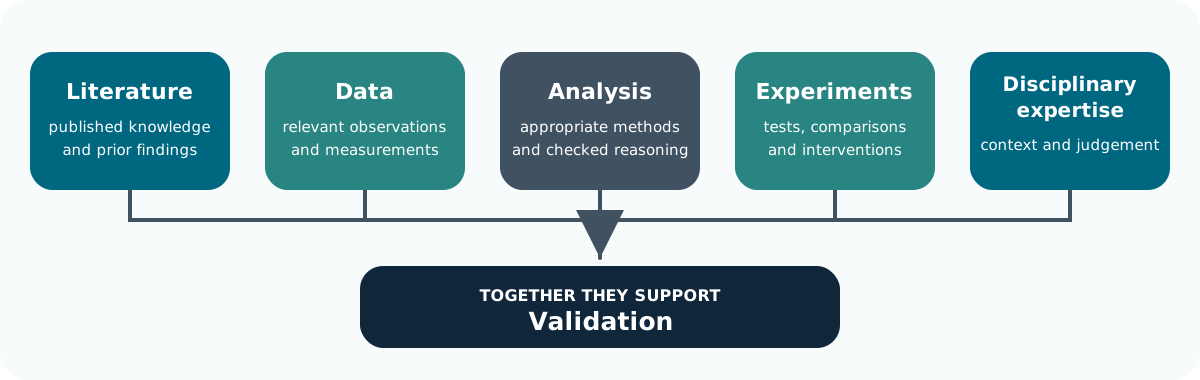
Agreement between several AI systems is not independent evidence.
🔎 The important question is whether the evidence supports the explanation.
Below are a few example of why writing might become more of a regular research task:
Name one alternative explanation and one piece of evidence that could help distinguish between them.
AI response (Codex GPT-5.6 Sol):
| Explanation | Alternative | Useful evidence |
|---|---|---|
| Protected time | Approaching deadline | Writing patterns inside and outside scheduled sessions |
| Accountability | Existing motivation | Attendance, prior writing habits and engagement |
| Confidence | Supervisory support | Changes in confidence alongside other sources of support |
The take home is that AI can generate competing explanations. The evidence determines which remain plausible.
An early exploration, a narrative review and a systematic review are different kinds of work.
Decide the purpose, question and method before choosing a tool.
For a systematic or scoping review, work with an information specialist where possible.
Set the rules for which studies count, where you will search, how records will be selected and what information will be extracted.
Resources like PRISMA 2020 help teams plan out how they report this work transparently.
An automatically generated “deep research” report can help you get oriented.
But the “deep research” label does not mean that:
What you need to be asking yourself when using AI for review is: Could another researcher understand what was searched, selected, extracted and checked?
Break it down into its components:
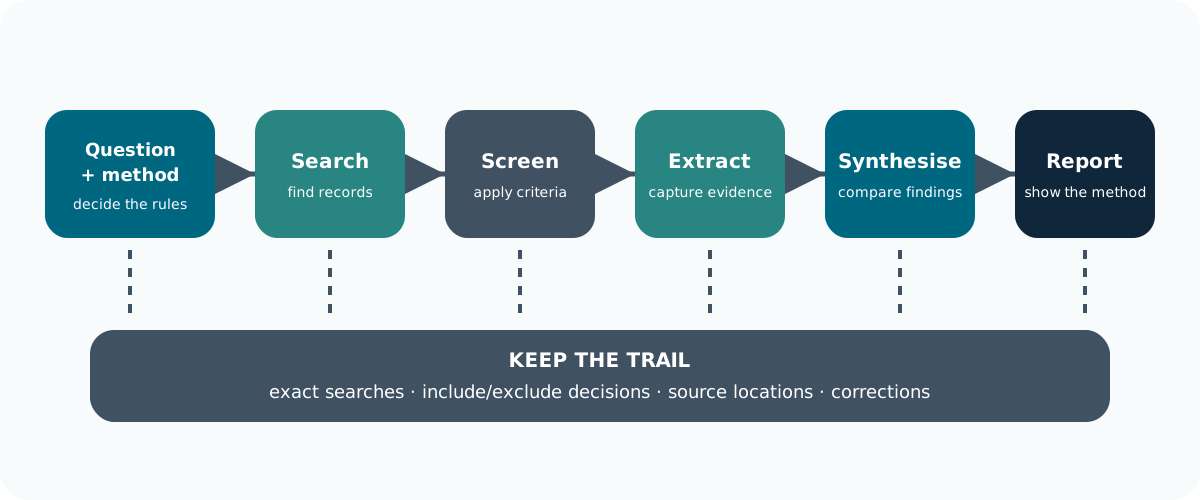
AI can help build a search, but you still need a clear method and a record of what you did.
🧭 Keep the exact search terms, database, date and filters used.
Use other routes to find papers that your first search may have missed.
| Route | What to do |
|---|---|
| AI-assisted discovery | Explore extra terms and candidate papers |
| Citation searching | Follow references backwards and citations forwards |
| Reference management | Export records and check for duplicates |
ResearchRabbit and Litmaps can help explore connections between papers.
Test AI on the papers that are hardest to classify, not just the obvious ones.
Document how automation was used and validated. The PRISMA expanded checklist addresses reporting automation in selection and data collection.
For each reference:
Follow the review protocol’s requirements for human review and resolving disagreements.
Use a structured evidence matrix, Do not let AI fill blanks with plausible values.
| Field | What to record |
|---|---|
| Identity | Paper ID, study ID, citation/DOI and source version |
| Design and setting | Method, population, recruitment, context and timing |
| Concepts and outcomes | What was studied, how it was measured, units and time points |
| Findings | Extracted result, uncertainty and the exact supporting location |
| Limitations | Reported limitations and your separate appraisal |
| Verification | Checked by whom, corrections and unresolved questions |
Once you have collated the evidence, organise the synthesis around the research questions, themes, theories or methods.
A useful review structure could be:
The aim is to turn the collected evidence into a clear, structured account of what is known, uncertain or still missing.
One way to keep claims attached is to ask AI to:
Do not treat AI generated counts of “positive” papers as proof: study quality, overlapping samples, uncertainty and whether studies are comparable all matter.
AI can absolutly overstate evidence to make semi-fictious claims;
| Source | What it found | Important limitation |
|---|---|---|
| A | Confidence increased during a six-week writing group | No comparison group; writing output not measured |
| B | Participants valued protected time and encouragement | Only attendees were interviewed |
| C | Attendees reported more weekly writing time | Other factors such as motivation or workload were not accounted for |
The studies may point in a similar direction, but they measure different things and do not prove the same claim.
Challenge this conclusion:
“Three studies prove that writing groups increased productivity, so universities should require attendance.”
Which single word least defensible? Why?
“Prove”
AI can help organise data, suggest interpretations and write code. But first decide:
🧭 Choose the method because it fits the research question — not because an AI tool can do it.
Before using AI, check what data you are sharing and where it is going.
🔒 Only share the minimum data needed for the task.
AI can help with some of the early, repetitive work and also help organise patterns and compare different parts of the dataset.
| Stage | AI can help with | You still need to |
|---|---|---|
| Transcription | Draft text and flag unclear sections | Check it against the recording |
| Reading the data | Find relevant passages and summarise sections | Read the full material yourself |
| Coding | Suggest labels or apply an existing codebook | Check that each code fits the text |
| Developing themes | Compare patterns and find contrasting examples | Decide what the patterns mean |
| Reporting | Organise extracts and challenge your explanation | Preserve context, anonymity and meaning |
MAXQDA AI Assist, for example, offers coding support, summaries and questions over text.
Before asking AI to analyse data, explain what each variable means, how the data were collected and what you want to test.
Start by checking the dataset itself:
🧭 Investigate and understand the data before transforming, modelling or interpreting it.
When using AI to produce code, ensure that it keeps the original data unchanged.
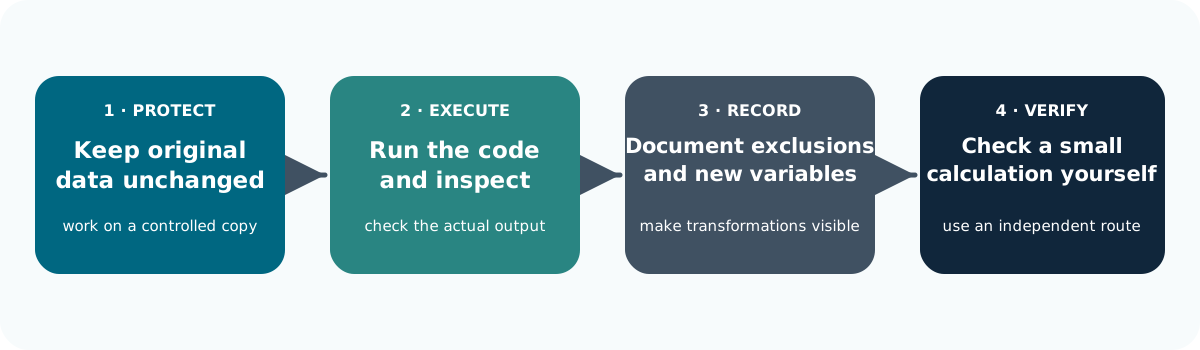
💻 A convincing answer does not prove that the calculation was actually run.
AI may suggest a statistical method without enough context.
| AI suggests | Ask |
|---|---|
| “Run a t-test” | Does this test fit the question and data? |
| “Remove outliers” | Are they errors, or genuine observations? |
| “Fill missing values” | Why are values missing, and is this appropriate? |
🔎 Treat statistical suggestions as proposals to check.
AI can also overstate what an analysis shows.
| AI says | Check |
|---|---|
| “This is significant” | What was tested, and what is the size of the effect? |
| “This predicts well” | Was it tested on new data? |
| “Use a bar chart” | Would another plot show the data more clearly? |
Use specialist statistical advice when the design or assumptions require it.
Fictional example, below are three feedback responses to a writing group:
AI Proposed conclusion: “Writing groups increase productivity for everyone.”
🔎 Does the evidence really support that conclusion?
**Fictional example, below is a table showing the started writing time per week at 0 and 6 weeks.
| ID | Baseline | Week 6 |
|---|---|---|
| P001 | 4 | 6 |
| P002 | 3 | 4 |
| P003 | 5 | NA |
| P004 | 2 | 2 |
| P005 | 6 | 5 |
| P006 | 4 | 4 |
N.b. NA means missing, not zero.
AI Proposed conclusion: “Writing time increased, proving the group was effective.”
For either the qualitative or quantitative examples we have just looked at. Identify what the AI got wrong
AI Proposed conclusion: “Writing groups increase productivity for everyone.”
| ID | Baseline | Week 6 |
|---|---|---|
| P001 | 4 | 6 |
| P002 | 3 | 4 |
| P003 | 5 | NA |
| P004 | 2 | 2 |
| P005 | 6 | 5 |
| P006 | 4 | 4 |
AI Proposed conclusion: “Writing time increased, proving the group was effective.”
The extracts support protected time, encouragement, an access barrier and an alternative influence from supervision.
They do not establish universal benefit, higher output or causation. Check retained quotations exactly, seek contrary cases and record how the researcher’s expectations shaped interpretation. Three extracts are not a completed thematic analysis.
There are six unique IDs but only five complete pairs. Their changes are 2, 1, 0, −1 and 0 hours/week: a mean of 0.4.
Report P003 as unavailable for the paired calculation and retain the record. The mean conceals variation, and these data do not establish effectiveness.
Different levels of automation suit different kinds of tasks.
🤖 Start with a process that already works, then decide whether automation actually saves time.
A bounded research agent receives approved inputs, uses limited actions, produces a draft and run log, obeys stop conditions, and pauses for a human decision.
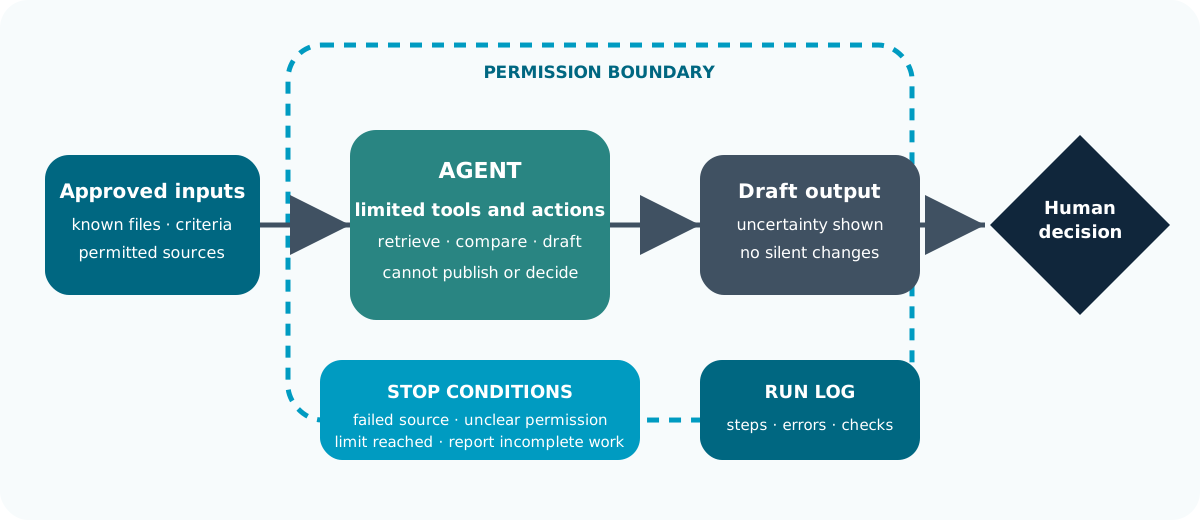
Automation works best when you know where a person should stop and check the work.
| Repeated task | AI can help with | Human check |
|---|---|---|
| Literature monitoring | Find new papers and possible duplicates | Decide what is relevant |
| Document extraction | Pull the same information from many papers | Check the source and missing information |
🧭 Automate repeatable steps, not final research decisions.
AI can help prepare and organise the work, but research judgement should stay with the researcher.
| Task | AI can help with | Human check |
|---|---|---|
| Analysis reporting | Run scripts and prepare tables or figures | Check results and interpretation |
| Grant preparation | Compare a draft with the funding call | Check eligibility, costs and commitments |
AI can prepare material for review. The researcher makes the decision.
An agent could regularly prepare a draft list of new papers.
The result is a list for review, not an automatic decision.
Our example agent should distinguish between:
No new papers found
and
The search did not work
A failed database connection or unreadable file should be reported, not treated as an empty result.
🔎 Automation needs clear failure checks.
Decide in advance what the agent should be able to do modern agent can control you entire computer! What do you need it to do?
Use read-only access where possible and start with a small test.
Web pages and PDFs may contain text telling an AI agent to change what it is doing.
This is known as prompt injection.
Agents should be set to treat retrieved material as content to analyse, not new instructions to follow.
🔒 Limit what the agent can access and do.
Set clear limits so the agent knows what it can do and where it must stop.
Clear permissions reduce the chance of unexpected actions.
In our example the agent should stop and ask for help when:
It should report what worked, what failed and what still needs review.
Start with a small example where you already know the answer.
Include:
Check what the agent misses or gets wrong, not just what it gets right.
Repeat the test when the model, data or workflow changes.
For a literature-monitoring agent, what do you think are the single most important stop condition?
Good stop conditions include an unreadable input, failed search, changed schema, unclear permission or exceeded limit.
Human approval should remain before final inclusion, deletion, external communication or publication. Test both a normal case and a known failure case.
Provide the current funding call, eligibility rules, assessment criteria, word limits and an approved project brief. Ask AI to list the requirements before it drafts any prose. Record the call version and deadline, then verify them on the funder’s original page.
| Application task | Useful AI support | What the team must supply or check |
|---|---|---|
| Assessing fit | Map the project to the call’s priorities and eligibility criteria | Actual eligibility and strategic fit |
| Planning the application | Build a section checklist, timetable and evidence map | Owners, time available and internal submission deadlines |
| Drafting and editing | Structure the argument, clarify language and reduce word count | Original ideas, evidence, accurate claims and permitted use |
Make sure you are not inventing early findings, collaborators, letters of support, costs or promised outcomes.
AI can imitate a reviewer and give a score, ranking or funding recommendation.
Whilst this is super helpful, it does not know:
🎯 Use AI feedback to find weaknesses and improve clarity, not to predict whether a proposal will be funded.
AI is good at estimating workloads, costs and project and breakdown. You can use it to chack:
| Application task | Useful AI support | What the team must supply or check |
|---|---|---|
| Work packages and impact | Identify unclear dependencies, outputs and assumptions | Feasible methods, partner commitments and credible routes to benefit |
| Budget and resources | Check consistency between narrative and a supplied costing sheet | Approved rates, arithmetic, eligibility and research-office sign-off |
| Critical review | Identify weak links against the published criteria | Research quality and final submission decisions |
Under the UKRI policy checked on 14 September 2026, applicants are expected to be transparent about substantial AI use, while minor help with language or formatting need not be disclosed.
People must remain involved in developing an application or its sections.
Take note; AI use during application interviews is prohibited.
UKRI assessors may use AI only for language refinement within the specified restrictions:
Read the policy for the applicable role and check the particular funding opportunity before use. Other funders may set different conditions.
Below is an example prompt for reviewing a application draft:
Use only the supplied fictional call and project notes.

Create a table: criterion; evidence already present; missing information;
question for the project team; proposed revision.

Quote or locate the relevant call requirement.

Do not invent findings, partnerships, commitments, costs or eligibility.

Flag conflicts between the work plan, proposed methods and resources.

Suggest revisions for human review; do not submit anything.
🧭 The aim is to identify gaps and strengthen the draft while keeping all claims grounded in the supplied evidence.
A funder will provide up to £5,000 for a six-month pilot that supports doctoral researchers.
The application must explain:
🧭 Your job is to show clearly how the proposed project meets each requirement of the call.
No timetable, no plan for people who do not attend and no cost for the facilitator.
What is the biggest problem with this application?
The project idea is reasonable, but the claim is too strong and some important details are missing.
A stronger application would:
Before sharing research material with AI, ask: am I allowed to put this here?. Alway check:
Removing names may not be enough to make someone anonymous.
🔒 Having access to information does not automatically mean you can upload it to an AI service.
A service may not use your data directly, but it may still store and process it.
Check:
🧭 Many modern tools use your date for more than training.
You often do not need real research data to test an AI workflow.
Ways around this problem incldude using:
fake data · example texts · Blank templates · Data structures
🔒 When in doubt, use the minimum information needed.
What you should always be looking out for:
| Risk | What to do |
|---|---|
| Invented links | Check that the source exists and says what AI claims |
| Unsupported conclusions | Go back to the original evidence |
| Overconfident answers | Ask what evidence might challenge the answer |
AI is predictive responses. Even if its ouput is fluent it can still be wrong.
What is contectually missing?
| Risk | What to do |
|---|---|
| Bias | Look for missing groups, viewpoints or evidence |
| Lost context | Return to the full paper, interview or dataset |
| Fabricated evidence | Never present generated material as real research data |
🧭 A polished answer is not necessarily an accurate one.
Record enough information to understand what AI contributed.
Keep track of:
📝 Record the process, not just the final answer.
AI output is rarely the end of the research process.
What did AI produce?
What did you check?
What was wrong?
What did you keep, change or reject?
This makes your decisions easier to explain later.
AI systems change over time and may give different answers to the same question.
Search results and available models can change too.
Keep important outputs and decisions.
🔎 A saved prompt alone may not reproduce what happened.
AI cannot take responsibility for research. Researchers remain responsible for:
Responsibility cannot be delegated. Make sure you stay upto date with the rules set by the institution, funders and publishers you work with.
You want to upload interview transcripts to an AI tool to help identify themes.
You have:
What would you do next?
Removing names is not enough on its own.
Before uploading, check:
If this is unclear, use fake or simplified data until permission is confirmed. The safest AI workflow often starts by changing the input, not accepting the risk.